
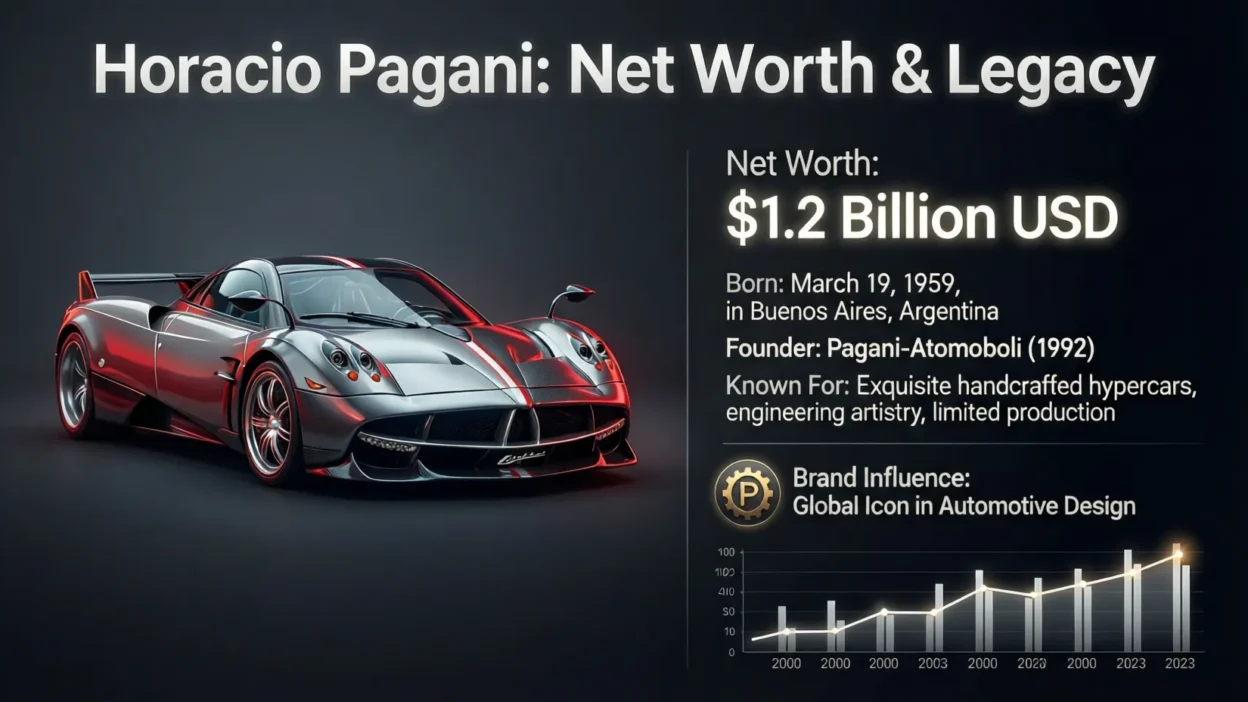
In the world of luxury hypercars, few names carry as much prestige as Horacio Pagani. Born in Argentina and driven by an unwavering passion for engineering and design, Pagani transformed his vision into one of the most exclusive automotive brands in the world. From the groundbreaking Zonda to the awe-inspiring Huayra, his creations are not just cars—they are works of art, admired by collectors and enthusiasts globally. But beyond the sleek carbon-fiber bodies and mind-bending horsepower, many wonder: how much is the man behind these masterpieces actually worth? Horacio Pagani’s net worth reflects decades of innovation, craftsmanship, and dedication to perfection. In this article, we’ll explore the journey of Pagani’s career, his rise to prominence in the automotive industry, the financial empire he has built, and the lifestyle of a man whose name has become synonymous with automotive excellence.
2. Early Life and Background
Horacio Pagani was born on November 10, 1955, in Casilda, a small town in the Santa Fe province of Argentina. From a young age, he displayed an insatiable curiosity for machines, often dismantling and rebuilding engines, cars, and motorcycles in his family’s garage. His passion for engineering was evident, but what truly set him apart was his artistic approach—he didn’t just want machines to work; he wanted them to perform flawlessly while looking beautiful.
Pagani’s upbringing in a modest family instilled in him the values of hard work, dedication, and perseverance. Despite limited resources, he nurtured his dream of designing cars that combined cutting-edge technology with bespoke craftsmanship. Fascinated by European automotive engineering, he idolized pioneers in the industry and studied their designs meticulously, developing a keen understanding of aerodynamics, materials, and performance.
At a young age, Pagani began experimenting with composite materials, such as carbon fiber, which would later become a hallmark of his hypercars. Determined to turn his passion into a career, he moved to Italy in the late 1970s, a bold step that allowed him to study under some of the best minds in automotive engineering. This formative period not only honed his technical skills but also laid the foundation for his future as a designer of some of the most exclusive and sought-after cars in the world.
3. Career Beginnings
After moving to Italy, Horacio Pagani quickly immersed himself in the world of high-performance automotive engineering. His first major break came when he joined Lamborghini in the late 1970s, where he worked in the composites department. At Lamborghini, Pagani honed his expertise in advanced materials such as carbon fiber and Kevlar—techniques that would later define the lightweight construction of his own hypercars. His talent did not go unnoticed; within a few years, he was entrusted with critical projects, contributing to the development of some of Lamborghini’s most iconic models.
Despite his growing success, Pagani felt constrained by working under larger corporations. He wanted the freedom to merge art, engineering, and performance on his own terms, rather than following corporate guidelines. This ambition led him to establish his consultancy firm, Modena Design, in the 1980s, where he began designing custom car parts and complete vehicle projects for high-end clients. His reputation for precision, creativity, and innovation quickly grew among automotive enthusiasts and elite car manufacturers.
These early ventures were critical in shaping Pagani’s vision for his own automotive brand. By combining meticulous craftsmanship with cutting-edge materials, he realized that there was a market for ultra-exclusive, artistically designed hypercars. These experiences laid the foundation for the next big step in his career—the founding of Pagani Automobili, a company that would eventually transform the hypercar industry forever.
4. Founding Pagani Automobili
In 1992, Horacio Pagani took a bold step that would cement his place in automotive history: he founded Pagani Automobili in Modena, Italy. Driven by a vision to create cars that were more than just vehicles, he sought to blend engineering excellence with artistic design, producing machines that were both powerful and visually stunning. Unlike traditional car manufacturers, Pagani focused on limited production runs, ensuring that each car was exclusive, meticulously crafted, and tailored to the client’s preferences.
The company’s first breakthrough came with the Pagani Zonda, introduced in 1999. The Zonda immediately garnered attention for its innovative use of carbon fiber, lightweight structure, and aerodynamic design. Each car showcased Pagani’s philosophy: performance without compromise, combined with the beauty of bespoke craftsmanship. His approach was revolutionary in an era dominated by mass-produced supercars, proving there was a market for ultra-exclusive hypercars.
Pagani Automobili’s reputation grew rapidly, attracting collectors, celebrities, and enthusiasts worldwide. By emphasizing quality over quantity and marrying art with technology, Horacio Pagani established his brand as a symbol of prestige and innovation. This foundation set the stage not only for the company’s future models, like the Huayra, but also for Pagani’s accumulation of substantial wealth, making him one of the most celebrated figures in the automotive world.
5. Major Achievements and Recognitions
Horacio Pagani’s career is marked by a series of groundbreaking achievements that have redefined the hypercar industry. The Pagani Zonda was his first masterpiece, earning global acclaim for its blend of lightweight carbon-fiber construction, cutting-edge aerodynamics, and striking design. Its successor, the Huayra, further solidified Pagani Automobili’s reputation, introducing active aerodynamics, advanced materials, and an unparalleled focus on driver experience.
Beyond his vehicles, Pagani has received numerous awards and honors for innovation and design. Automotive magazines and organizations frequently recognize his work as a fusion of engineering precision and artistic craftsmanship. Celebrities, collectors, and car enthusiasts often highlight the exclusivity of his cars, which are produced in extremely limited numbers, making each model a coveted collector’s item.
Pagani’s influence extends beyond car manufacturing. He has inspired a new generation of automotive designers and engineers, proving that passion and attention to detail can create vehicles that are both high-performance machines and works of art. These accomplishments have not only earned him prestige in the automotive world but have also contributed significantly to his personal fortune, making Horacio Pagani a celebrated figure among the world’s elite entrepreneurs and luxury car innovators.
6. Horacio Pagani’s Net Worth
Horacio Pagani’s net worth reflects decades of innovation, craftsmanship, and dedication to creating some of the most exclusive hypercars in the world. As of 2026, his estimated net worth is around $100 million to $150 million, though exact figures are difficult to confirm due to the private nature of his company, Pagani Automobili. Unlike mass-market car manufacturers, Pagani’s business model focuses on ultra-limited production, with each vehicle priced in the millions of dollars, contributing significantly to his wealth.
His fortune comes primarily from the sales of Zonda, Huayra, and limited-edition models, as well as the company’s continued prestige among collectors and luxury enthusiasts. Additionally, Pagani’s consultancy work, collaborations with high-end clients, and intellectual property related to advanced composites and car design have added to his financial success.
Compared to other automotive billionaires, Pagani’s wealth may seem modest, but it’s important to note that his focus has always been quality and exclusivity over mass profits. His net worth is a direct reflection of his philosophy: creating artful, high-performance vehicles that are as rare as they are desirable, cementing his legacy not just as a wealthy entrepreneur but as one of the most revered automotive designers of his generation.
7. Lifestyle and Assets
Horacio Pagani leads a lifestyle that mirrors the elegance and exclusivity of his hypercars. Despite creating vehicles that cost millions, Pagani is known for maintaining a private and low-key personal life, focusing more on craftsmanship than flashy displays of wealth. His homes and studios, primarily located in Modena, Italy, are hubs of innovation, filled with design prototypes, carbon-fiber components, and his personal collection of rare cars.
Pagani’s assets include not only his company but also a personal collection of luxury and classic automobiles, many of which reflect his passion for automotive history and innovation. Beyond cars, he invests in cutting-edge materials, technology, and bespoke projects, ensuring that his wealth supports both creativity and long-term growth.
Though he lives comfortably, Pagani’s wealth is largely tied to his business rather than ostentatious purchases. He has occasionally engaged in philanthropy and educational initiatives, supporting young engineers and automotive students who aspire to follow in his footsteps. His lifestyle exemplifies a balance between passion, art, and prudent financial management, showing that his net worth is not just about money—it’s about sustaining a legacy of innovation, exclusivity, and automotive excellence.
8. Challenges and Controversies
While Horacio Pagani is celebrated as a visionary, his journey to success was not without challenges. One of the biggest hurdles was breaking into a highly competitive automotive market dominated by established giants like Ferrari, Lamborghini, and McLaren. Convincing collectors and enthusiasts to invest in a brand that was entirely new—and producing cars at prices often exceeding several million dollars—required not just innovation but immense credibility and persistence.
Production limitations also posed significant challenges. Pagani’s insistence on handcrafted, bespoke vehicles meant that output was extremely low, making it difficult to scale the business and meet global demand. Each car took months, sometimes years, to complete, which required careful planning and patience from both the company and its clients.
Despite his careful approach, Pagani has occasionally faced criticism for the high price points of his vehicles or delays in deliveries. Some skeptics questioned whether such exclusivity could sustain a long-term business. However, Horacio navigated these controversies by staying true to his philosophy: quality over quantity, craftsmanship over mass production. These challenges ultimately strengthened the brand, reinforcing its reputation as a symbol of luxury, artistry, and engineering perfection, and proving that overcoming obstacles is integral to lasting success in the hypercar industry.
9. Lessons from Horacio Pagani’s Success
Horacio Pagani’s journey offers valuable lessons for entrepreneurs, engineers, and enthusiasts alike. First and foremost, his story underscores the power of passion and vision. From a young boy fascinated by machines to the founder of one of the world’s most prestigious hypercar brands, Pagani shows that pursuing what you love can lead to extraordinary achievements.
Another key lesson is the importance of craftsmanship and attention to detail. Pagani’s cars are not just vehicles—they are works of art. By prioritizing quality, innovation, and precision over mass production, he created a brand that commands respect and loyalty worldwide. This demonstrates that excellence often outweighs quantity in building a lasting reputation.
Pagani’s career also highlights the value of resilience and perseverance. He faced financial constraints, production challenges, and skepticism from established competitors but remained committed to his vision. His ability to overcome obstacles while staying true to his principles is a blueprint for long-term success.
Finally, Pagani emphasizes the intersection of art and technology. He shows that combining creativity with engineering innovation can create products that are both functional and emotionally captivating. His story inspires others to blend their skills and passions, proving that dedication, innovation, and artistry can turn dreams into reality.
10. Conclusion
Horacio Pagani’s journey from a young Argentine engineer to the founder of one of the world’s most prestigious hypercar brands is a story of vision, passion, and relentless dedication. His net worth, estimated between $100 million and $150 million, reflects not just financial success but decades of innovation, creativity, and commitment to excellence. Unlike many in the automotive industry, Pagani built his fortune by focusing on quality, exclusivity, and craftsmanship, creating vehicles that are as much works of art as they are engineering marvels.
Beyond his financial achievements, Pagani’s legacy lies in the lasting impact he has made on automotive design. The Zonda, Huayra, and other limited-edition models continue to inspire car enthusiasts, designers, and collectors around the world. His story demonstrates that true success is not measured solely by wealth, but by the ability to turn passion into a lasting, influential brand.
For aspiring entrepreneurs and car lovers alike, Horacio Pagani is a testament to what can be achieved with vision, perseverance, and attention to detail. From humble beginnings to global acclaim, his life proves that dedication and creativity can produce both extraordinary cars and a remarkable legacy in the luxury automotive world.